According to Traditional Chinese Medicine (TCM), there are seven emotions: joy, anger, worry or concern, sadness, brooding, fear, and fright. If these emotions are exaggerated and out of balance, then Qi and blood in the body are also out of balance, and various illnesses arise. Emotions should therefore always be regulated and kept in harmony. If this is not the case and, for example, joy or fear is excessive, the free flow of Qi and blood is blocked. This, in turn, affects the organs and causes pathological changes.
On the physical level, there are the so-called six “needs”: the eyes see, the ears hear, the mouth tastes, the nose smells, the body can feel, and the mind can perceive. If these “needs” become too strong, one loses Qi, becomes ill, and life is shortened. A simple example is persistent overeating.
The connections between emotions and organs
Joy and the Heart Are Connected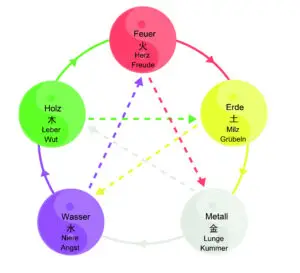
Joy allows Qi and blood to flow freely, enabling the muscles to relax. Joy gives the body renewed strength when it is tired. However, if joy is excessive, it harms the heart Qi. It becomes scattered, which in turn affects the spirit. This often leads to fear, insomnia, and dementia.
Anger and the liver are connected
Anger harms the liver. It is a common emotion. Persistent anger causes Qi to rise upward. This damages the liver and leads to feelings of unhappiness and dizziness; eye pain or high blood pressure may occur. Anger is a major cause of high blood pressure, but also of coronary artery disease, gastritis, stroke, and other illnesses.
Grief and worry affect the lungs
Severe grief and worry harm the lungs. As a result, dry cough, shortness of breath, or coughing up blood may occur. In addition, the voice may disappear and the breathing rate may change.
Sadness affects the lungs
Sadness is a very intense form of worry. It appears when one has many worries and suffers greatly. Persistent, severe sadness harms lung Qi, heart Qi, liver Qi, and spleen Qi, leading to pathological changes. With weakened lung Qi, one has little motivation for life and depression may occur. Further consequences include shortness of breath, discomfort in the chest area, and persistent fatigue. Over time, the liver is also damaged, which can lead to confusion of the spirit, blocked tendons, and sweating all over the body.
Too much persistent sadness also harms the heart Qi. This gives rise to fear and the spirit becomes confused. If this condition intensifies, the spleen and stomach are also affected, leading to digestive problems and abdominal pain. The muscles become increasingly weak. If such conditions are caused by sadness, they can be healed by allowing patients to experience more joy.
Brooding harms the spleen
According to TCM, brooding blocks Qi. Then the functions of the nervous system are in disharmony and only a small amount of digestive fluids is produced. This leads to loss of appetite, weight loss, shortness of breath, weakness of Qi and the limbs, and little desire to move. Another effect is sadness.
Fear harms the kidneys
Fear harms the kidneys and the nervous system, leading to tinnitus and deafness, dizziness, impotence, and it can even result in death. The world in which one lives influences emotions and thus also the person. It is therefore very important to remain as calm as possible in all events and to have positive thoughts. One should be positive in the heart area, develop gratitude and humility, understand the impermanence of things, remain calm, and preserve the spirit.
Fright harms the kidneys
Fright occurs when something unexpected suddenly happens or an accident occurs. Fright can also occur as the result of a very positive surprise. As a consequence, sudden severe nervousness and fear may arise, which harms the kidneys.

Body and mind form a unity, and both are connected through Qi. Emotional activity influences the flow of Qi inside the body, and therefore, with disharmonious emotions, the movement of Qi and blood also becomes chaotic. If this becomes a persistent state, it harms the internal organs and can lead to illness. Different emotional arousals influence the flow of Qi in the body in different ways.
Joy slows the flow of Qi. This normally reduces nervousness, calms the heart Qi, and one relaxes. Excessive joy, however, scatters Qi; the spirit can then no longer control Qi, one cannot concentrate, and confusion arises.
Anger makes Qi rise. If anger is very strong, liver Qi rises upward without restraint. This causes a chaotic state. If one often has sudden and severe outbursts of anger, the face becomes red, the eyes look angry, and one may even spit blood, or lose consciousness, or suffer a stroke.
Sadness suppresses Qi. With excessive sadness, lung Qi is strongly suppressed. This injures the lungs and consumes a great deal of Qi.
Brooding blocks Qi. Too much brooding harms the spirit and the spleen. This can lead to a blockage of the flow of Qi. In TCM, it is believed that brooding is connected with the spleen, but it also affects the heart. If one broods continuously, it harms not only the primary spirit and the heart area, but also the spleen, the stomach, and digestion. When the spirit is in disharmony, fear, restlessness, insomnia, and many dreams occur. The flow of Qi is blocked, the spleen’s transforming function is weak, and the stomach cannot work well. People then become mentally inflexible. They act as if they were stupid and feel unwell.
Fear makes Qi sink. Excessive fear causes kidney Qi to become unstable and Qi is lost downward. Clinical practice shows that in such cases one can no longer control the urge to urinate and bowel movements. Persistent fear harms the essence and kidney Qi. Possible consequences include weak bones and nocturnal emissions.
A sudden fright leads to a chaotic Qi state. This injures kidney and heart Qi, and the spirit can no longer control Qi. Then one can no longer think or plan well and becomes confused.
According to TCM, the seven emotions described correspond to normal emotions and normal psychological activities. In addition to them, there are also love and hate, pride and shyness, dignity and contempt. These pairs also represent normal emotional reactions that influence Qi and health. Harmonising the emotions plays a major role for health and vitality. By practising Qigong, it is possible in a simple, effective, and self-determined way to build up and stabilise Qi harmoniously. This also brings the emotions into balance and creates a good foundation for health.